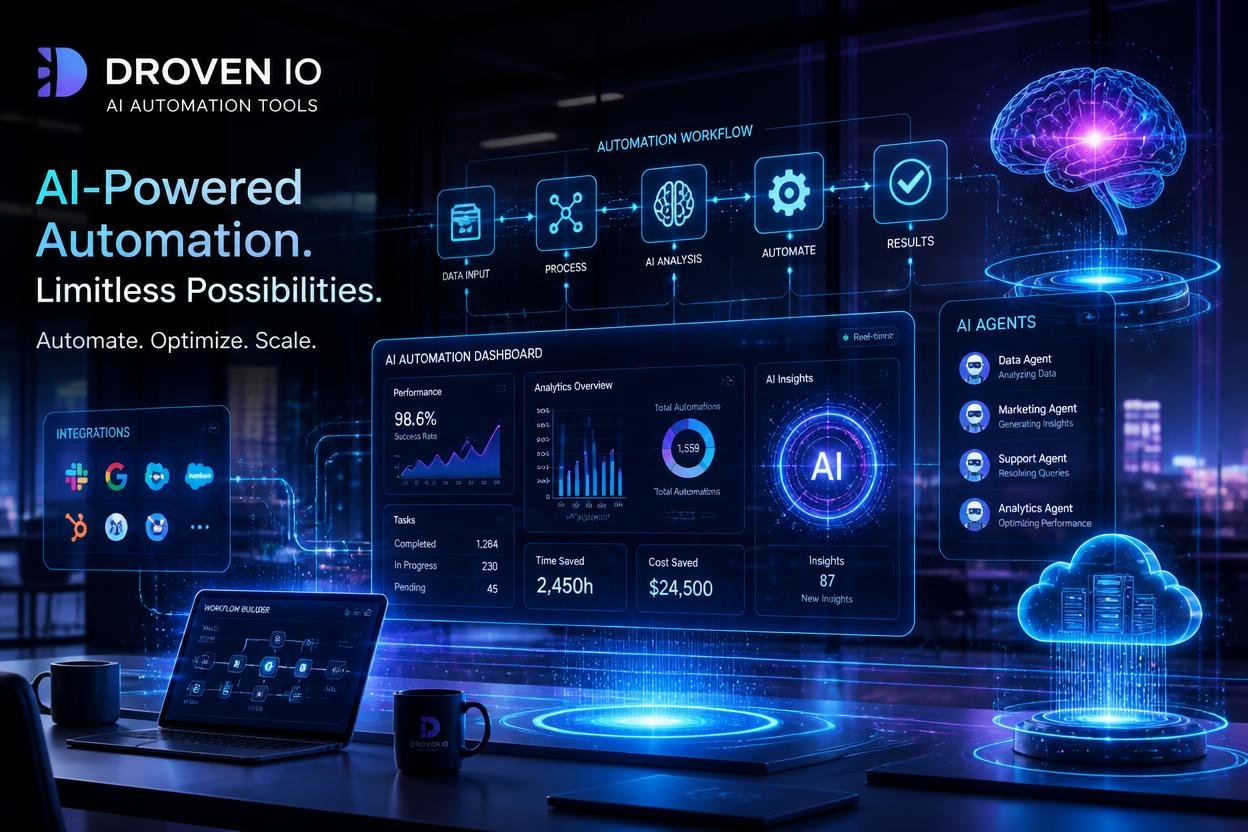
The world of AI automation is moving at lightning speed. Businesses no longer want tools that simply store data or generate reports. They want systems that can think, analyze, predict, and even take action automatically. That demand has pushed platforms like Droven.io and Draiven AI into the spotlight as organizations search for smarter ways to automate operations, decision-making, and productivity.
What makes Droven IO AI automation tools interesting is that the name has become associated with multiple AI-related platforms and discussions online. Some users refer to Droven.io as an educational resource for AI and robotic process automation, while others connect the “Droven” brand with prompt management workspaces and AI workflow systems. At the same time, platforms like Draiven are building enterprise-grade AI agents capable of analyzing business data and executing tasks across connected systems.
What Is Droven IO?
When people search for Droven IO AI automation tools, they usually encounter two different concepts online. One is an educational technology platform focused on artificial intelligence, robotic process automation, cloud computing, and digital transformation. The other relates to emerging AI workspace tools designed for prompt engineering, workflow management, and automation systems.
According to the platform’s public information, Droven.io positions itself primarily as an educational resource rather than a software vendor. It explains AI concepts, automation trends, and RPA systems in beginner-friendly language designed for both technical and non-technical readers.
That educational approach matters more than many people realize. AI automation has become incredibly complex. Terms like “autonomous agents,” “semantic analysis,” “workflow orchestration,” and “predictive automation” can overwhelm business owners who simply want to save time and reduce repetitive work. Platforms that simplify those ideas play a major role in AI adoption.
At the same time, the broader “Droven” ecosystem also includes AI-powered prompt workspaces and workflow tools. For example, Droven Cloud describes itself as a workspace for organizing, enhancing, and managing prompts for large language models.
This overlap highlights how automation is no longer limited to simple “if-this-then-that” systems. Modern AI tools are becoming collaborative digital assistants capable of understanding human intent, improving prompts, and optimizing workflows dynamically.
The Educational Side of Droven.io
One reason Droven IO AI automation tools continue gaining attention is accessibility. Many AI platforms assume users already understand machine learning, APIs, or data engineering. Droven.io takes the opposite approach by explaining automation in plain language.
For example, robotic process automation is often described technically as “software robots executing deterministic business tasks.” That sounds intimidating. Educational platforms instead explain it as software handling repetitive work like data entry, invoice processing, or report generation. Suddenly, automation becomes understandable.
This matters because AI adoption depends heavily on clarity. A small business owner doesn’t care about neural network architectures. They care about whether AI can answer customer emails faster, automate scheduling, or improve marketing campaigns.
In many ways, educational AI platforms act like translators between advanced technology and practical business value. They reduce fear, eliminate confusion, and make automation feel approachable rather than threatening.
The Rise of AI Workflow Platforms
The second side of the Droven IO AI automation tools conversation involves AI workflow systems themselves. These platforms focus on helping users create intelligent processes using natural language, AI prompts, and connected applications.
Modern workflow tools differ dramatically from older automation systems. Instead of manually programming every condition, users can increasingly describe what they want in simple English. AI interprets the intent, creates workflows, maps data fields, and automates tasks automatically.
That shift changes everything.
Traditional automation felt like building a machine from scratch with hundreds of screws and wires. AI automation feels more like hiring a smart assistant who already understands business operations.
This evolution is pushing AI automation into mainstream business environments much faster than previous software revolutions.
Understanding AI Automation Tools
AI automation combines artificial intelligence with workflow automation to create systems capable of performing tasks with minimal human intervention. Unlike static automation, AI systems can adapt, learn patterns, analyze data, and improve decisions over time.
That adaptability is the biggest difference between older automation tools and modern AI systems.
How Traditional Automation Differs From AI Automation
Traditional automation follows rigid instructions. If a condition changes unexpectedly, the workflow usually breaks. AI automation introduces flexibility by analyzing context rather than simply following rules.
Think of traditional automation like a train on fixed tracks. It performs perfectly until something blocks the route. AI automation is more like a self-driving car capable of adjusting routes, recognizing obstacles, and making decisions independently.
For example:
| Traditional Automation | AI Automation |
|---|---|
| Fixed workflows | Adaptive workflows |
| Rule-based logic | Context-aware reasoning |
| Requires manual updates | Learns from patterns |
| Limited flexibility | Dynamic responses |
| Basic task automation | Intelligent decision-making |
This flexibility explains why businesses increasingly prioritize AI-driven systems over conventional automation software.
Why Businesses Are Investing in AI Workflows
Organizations are under constant pressure to move faster while reducing costs. AI automation offers both advantages simultaneously.
Research from enterprise AI platforms shows businesses using advanced AI analytics can significantly reduce manual analysis time while accelerating operational decisions. Draiven, for example, claims businesses can save up to 80% of analytical time and achieve decisions in under 60 seconds.
That speed matters because modern business environments move like Formula 1 races. Waiting days for reports or manually analyzing spreadsheets creates competitive disadvantages.
AI automation helps companies:
- Detect trends faster
- Respond to customers instantly
- Reduce repetitive work
- Improve forecasting accuracy
- Streamline communication
- Automate complex operations
The result is not just efficiency. It’s operational intelligence.
Core Features Found in Modern AI Automation Platforms
AI automation platforms now combine multiple capabilities into unified ecosystems. Instead of using separate tools for analytics, workflows, reporting, and communication, businesses increasingly prefer integrated AI systems.
Intelligent Data Analysis
Modern AI systems can analyze massive datasets across CRMs, ERPs, APIs, and databases simultaneously. Platforms like Draiven AI position themselves as “operational brains” capable of understanding business context and generating insights automatically.
That’s a major leap forward from traditional dashboards.
Old dashboards displayed numbers. AI systems explain why numbers changed, identify root causes, and suggest actions automatically.
Imagine asking:
“Why did sales drop in the northern region last month?”
Instead of manually checking dozens of spreadsheets, an AI system can instantly identify pricing changes, customer churn, or inventory problems. That transforms analytics from reactive reporting into proactive intelligence.
Workflow Automation
Workflow automation remains the backbone of AI productivity systems. AI-powered workflows can connect tools like Gmail, Slack, Salesforce, Google Sheets, CRMs, payment systems, and marketing platforms.
What’s changing is the interface.
Instead of dragging boxes visually for hours, users increasingly describe workflows conversationally. AI interprets the request and generates automations automatically.
That natural-language interaction dramatically lowers the technical barrier for businesses adopting automation.
AI Agents and Cognitive Systems
One of the most exciting trends involves AI agents. These are specialized AI systems capable of handling different responsibilities autonomously.
Draiven describes its system as a team of AI specialists, including:
- Sales strategists
- Finance analysts
- Marketing experts
- Operations optimizers
- Executive advisors
- Data detectives
These agents collaborate dynamically depending on the problem being solved.
This approach resembles a digital workforce rather than a simple software tool.
Prompt Engineering and AI Workspaces
Another rapidly growing category involves prompt management and AI workspaces. Tools associated with the Droven name focus on organizing prompts, version control, AI enhancement, and collaborative workflows for creators and developers.
Prompt engineering has become incredibly important because AI output quality depends heavily on instructions. Businesses using an AI ad maker now treat prompts almost like software assets requiring documentation, optimization, testing, and version tracking.
That’s why AI workspaces are becoming essential for companies using large language models extensively.
Draiven and the Operational AI Revolution
While Droven.io focuses heavily on AI education, platforms like Draiven AI demonstrate what enterprise automation looks like in practice.
Real-Time Business Intelligence
Draiven emphasizes semantic analysis and operational intelligence. Instead of merely answering questions, the platform analyzes business systems deeply and executes actions directly across workflows.
This represents a shift from “AI assistant” to “AI operator.”
For example:
- AI identifies declining revenue
- Analyzes customer churn
- Detects pricing issues
- Recommends corrective actions
- Executes updates automatically
That level of automation creates entirely new operational possibilities.
Multi-Agent AI Systems
Multi-agent systems are becoming one of the hottest trends in enterprise AI. Rather than relying on one giant model handling everything, companies deploy specialized AI agents collaborating together.
This structure improves:
- Accuracy
- Scalability
- Decision quality
- Explainability
- Operational efficiency
It’s similar to how companies organize human departments. Instead of one employee doing everything, specialists collaborate within a coordinated system.
Benefits of Using AI Automation Tools
The popularity of Droven IO AI automation tools reflects broader business demand for smarter operations.
Increased Productivity
AI automation dramatically reduces repetitive work. Employees spend less time copying data, generating reports, or handling administrative tasks.
That productivity boost compounds over time like interest in a savings account. Small efficiencies eventually create massive operational advantages.
Reduced Human Error
Humans make mistakes when performing repetitive tasks repeatedly. AI systems reduce inconsistencies by executing workflows systematically.
This is especially valuable in industries requiring high accuracy like finance, healthcare, and logistics.
Faster Decision-Making
Speed often determines competitive advantage. Businesses capable of responding quickly outperform slower competitors.
AI systems accelerate decision-making by processing information instantly instead of waiting for manual analysis.
Industries Being Transformed by AI Automation
AI automation is no longer limited to tech companies. Nearly every industry now integrates intelligent workflows.
Healthcare
Hospitals use AI automation for:
- Appointment scheduling
- Medical record management
- Diagnostic assistance
- Patient communication
- Insurance processing
Healthcare automation reduces administrative burden while improving patient experience.
Finance
Banks and financial institutions automate:
- Fraud detection
- Risk assessment
- Loan approvals
- Compliance reporting
- Customer service
AI dramatically improves speed and accuracy in financial operations.
E-Commerce and Marketing
Online businesses use AI for:
- Personalized recommendations
- Customer segmentation
- Automated email campaigns
- Inventory forecasting
- Dynamic pricing
AI-driven marketing feels almost like having a digital strategist working around the clock.
Challenges and Risks of AI Automation
Despite its advantages, AI automation introduces important concerns businesses must address carefully.
Security and Privacy Concerns
AI systems often access sensitive business information. Poor security practices can expose customer data or internal operations.
Organizations must prioritize:
- Encryption
- Access controls
- Data governance
- Compliance standards
- Audit systems
Overdependence on Automation
Automation works best when paired with human oversight. Businesses that blindly trust AI without review can create serious operational risks.
AI should augment human decision-making, not replace critical thinking entirely.
How to Choose the Right AI Automation Platform
Choosing the right automation platform depends on business goals, technical complexity, and operational needs.
Key factors include:
- Ease of integration
- Security standards
- Workflow flexibility
- AI capabilities
- User experience
- Scalability
- Cost efficiency
Businesses should also evaluate whether they need:
- Educational resources
- Prompt management
- Enterprise analytics
- Workflow orchestration
- Multi-agent systems
Different platforms excel in different categories.
Future Trends in AI Workflow Automation
The next generation of AI automation will likely focus on:
- Autonomous AI agents
- Natural language workflow creation
- Predictive decision-making
- Real-time operational intelligence
- Multi-agent collaboration
- Self-improving workflows
Research into autonomous AI development frameworks already demonstrates how AI agents can manage coding, testing, execution, and operational tasks with minimal human intervention.
That suggests future AI systems may function more like digital employees than software tools.
Businesses adopting automation today are essentially preparing for a future where AI becomes deeply embedded in daily operations.
Conclusion
The growing interest in Droven IO AI automation tools reflects a larger transformation happening across industries worldwide. Businesses are moving beyond simple automation toward intelligent systems capable of analyzing data, understanding context, making recommendations, and executing actions automatically.
Platforms like Droven.io help educate users about AI, RPA, and digital transformation, while systems like Draiven AI showcase how advanced enterprise automation can operate in real-world environments. At the same time, AI workspaces focused on prompt engineering and workflow optimization are creating entirely new productivity categories.
AI automation is no longer optional for organizations trying to stay competitive. It’s becoming the operational nervous system of modern business.
The companies that learn how to combine human creativity with intelligent automation will likely dominate the next decade of digital transformation.
FAQs
What is Droven.io?
Droven.io is primarily an educational technology platform focused on AI, robotic process automation, cloud computing, cybersecurity, and digital transformation topics.
Are Droven.io AI automation tools real software products?
The Droven name appears across multiple AI-related projects online, including educational platforms and prompt workspace systems. Some platforms focus on AI education while others explore prompt engineering and workflow management.
What is Draiven AI?
Draiven AI is an enterprise AI platform that analyzes business data, generates insights, and executes operational actions using specialized AI agents.
How do AI automation tools improve productivity?
AI automation tools reduce repetitive tasks, accelerate data analysis, automate workflows, and support faster business decisions.
What industries benefit most from AI automation?
Healthcare, finance, e-commerce, logistics, customer support, marketing, and manufacturing are among the industries seeing major gains from AI-driven automation.